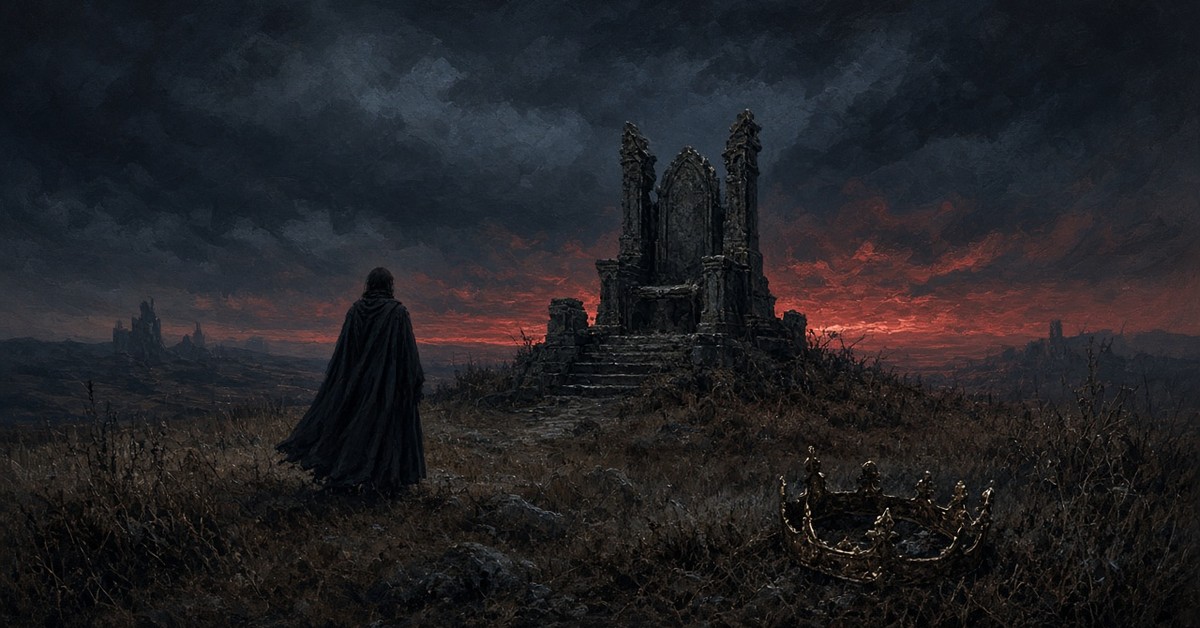
Every fantasy novel has darkness in it. There is a dark lord, a blighted land, or an army massing at the border. Yet readers know there is a difference between a story that contains darkness and a story that is dark. The first sends its heroes into shadow and brings them out again. The second asks whether anyone comes out at all, and what they are when they do.
Dark fantasy is a slippery label. Booksellers use it for grim political epics, for horror set in invented kingdoms, and for fairy tales told without the softening. What these books share is harder to pin down than a setting or a creature. It is a stance toward the world, and toward the reader.
The world does not bend toward justice
In much traditional fantasy, the universe has a moral shape. Good is rewarded, eventually. Evil carries the seeds of its own defeat. The prophecy will be fulfilled, and the rightful heir will take the throne.
Dark fantasy removes that guarantee. The gods, if they exist, may be indifferent or hostile. Prophecies may be lies, or true in ways that ruin the people who believe them. The rightful heir may be worse than the usurper. Characters act without any assurance that the world will honor their sacrifices.
This changes how every choice feels. When there is no promise that virtue will win, virtue becomes a decision a person makes again and again at real cost. A knight who keeps an oath in a world that punishes oath keepers is more moving than one who keeps it because the story has assured us it will pay off.
Magic that takes something back
In a dark fantasy, magic is rarely free. It is drawn from blood, from years of a life, from memory, or from the souls of others. Sorcerers grow hollow. Witches pay with their names. The spell works, and the person who cast it is diminished.
This is one of the clearest markers of the genre. Magic stops being a tool and becomes a temptation. Every use of it raises the question of what will be lost, and whether the caster is still choosing freely or has begun to be consumed. Readers feel the weight of each spell because each one has a price they can see.
There is an old root to this. Folklore across Europe is full of warnings about power gained through forbidden means. The cunning man who deals with spirits, the scholar who reads the wrong book, and the miller’s daughter who promises her firstborn all learn that power obtained without honest labor carries a hidden debt. Dark fantasy takes those warnings seriously.
The fairy tale with its teeth intact
Many readers first meet dark fantasy without knowing it, in the older versions of familiar fairy tales. The tales collected by the Brothers Grimm in the early nineteenth century include mutilation, cannibalism, and punishments that are far from gentle. Earlier tellings of Sleeping Beauty and Little Red Riding Hood are crueler still. These stories were not made for comfort. They were warnings about real dangers: hunger, predatory strangers, and families that turn on their own children.
Dark fantasy often returns to that source. It treats the forest as a place where people genuinely die. It remembers that wolves, witches, and enchanted bargains were metaphors for things that frightened ordinary people with good reason. When a modern dark fantasy draws on fairy tales, it usually restores the danger that later retellings removed.
Heroes who are compromised
The protagonists of dark fantasy are frequently damaged, guilty, or morally uncertain. A mercenary who has done terrible things, a necromancer who loves her family, and a soldier who follows orders he knows are wrong are all familiar figures. The genre is interested in what people become under pressure, and pressure rarely produces saints.
This does not mean dark fantasy is nihilistic. The best of it cares intensely about goodness. It refuses to make goodness easy. A compromised character who reaches for decency in a world that has given them every reason to abandon it can carry more moral force than any shining paladin.
For readers who love romance, this is fertile ground. Love between people who have done harm, who expect to be judged, and who do not believe they deserve tenderness has a gravity that lighter stories cannot match. The question is never only whether two people will come together. It is whether they can bear to be known.
Horror in the bones
Dark fantasy shares a border with horror, and the border is often unguarded. Monsters in dark fantasy are not obstacles to be defeated in a set piece. They are wrong in a way that disturbs the order of the world. The dead may not stay dead. Something may live beneath the city that the city was built to contain. A plague may be a punishment, or a hunger with a mind.
What separates dark fantasy from straight horror is usually scale and structure. Dark fantasy builds a world with history, politics, and geography, and then lets horror move through it. The reader is invested in kingdoms as well as characters, and the dread extends to the fate of entire peoples.
Why readers choose the dark
It is fair to ask why anyone would choose stories like these. The answer, I think, is that dark fantasy tells a certain kind of truth. Many readers know from experience that the world does not always reward the good, that power often corrupts, and that survival can require terrible compromises. Stories that pretend otherwise can feel thin to them.
Dark fantasy also offers something that brighter stories cannot. When hope appears in a dark world, it is precious because it is rare. A single act of mercy, a promise kept, or a love that persists through ruin means more against a black background. The genre does not deny light. It insists that light be paid for.
There is also the plain pleasure of atmosphere. Ruined cathedrals, plague towns, haunted battlefields, and forests where the paths shift are among the most evocative settings fiction has to offer. Readers who seek them out are not looking for despair. They are looking for intensity, and for stories that take fear, loss, and moral struggle as seriously as they deserve to be taken.
Where to begin
Readers coming to the genre might begin with the fairy tales themselves, read in collections that keep the older versions intact. From there, the classic sword and sorcery of the early twentieth century, the grim epics of recent decades, and the horror-inflected fantasies that blur the line between genres all offer different shades of the same darkness.
Pay attention to what holds you. Some readers love the moral struggle. Others love the creeping dread, or the beauty of a ruined world. Dark fantasy is wide enough for all of them. What it asks in return is a willingness to follow a story into places where nothing is certain, and to accept that some doors, once opened, cannot be closed.
Leave a Reply