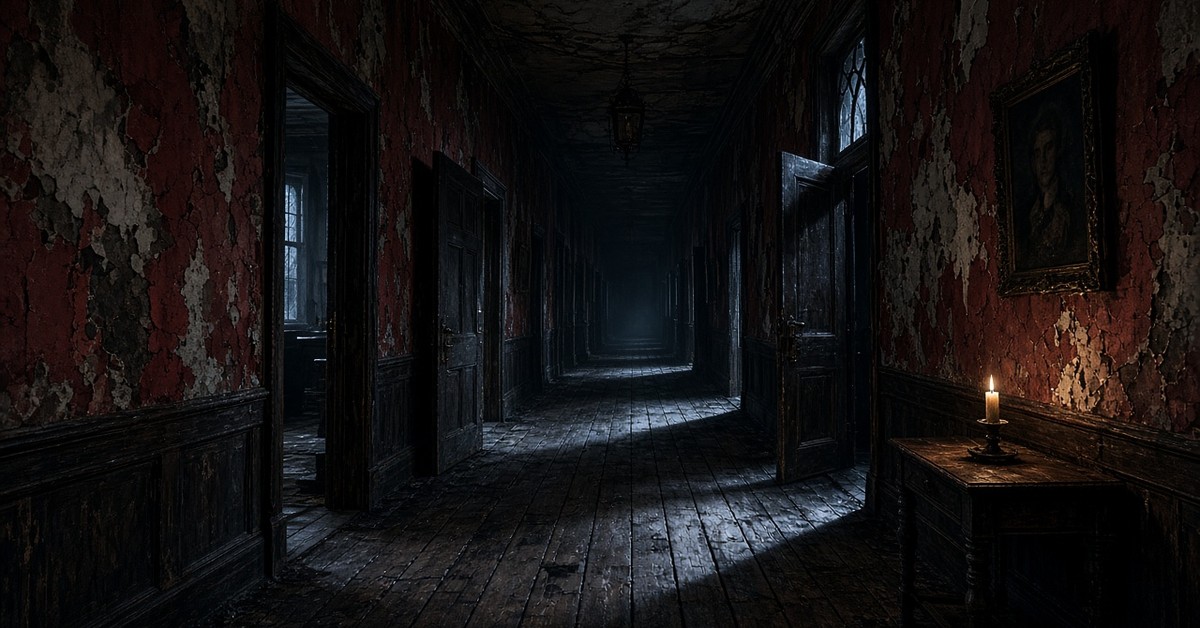
Some stories are set in a house. Others are about a house, and the difference shows within a few pages. In the first kind, the walls are scenery. In the second, the walls are listening. The house has moods, a history, and something close to a will. The characters move through it the way they would move through the presence of another person, careful of its temper, uncertain of its intentions.
The haunted house is one of the oldest shapes in the literature of fear, and it remains one of the most powerful. This piece looks at why, and at what separates a house that merely contains ghosts from a house that is itself the haunting.
A house that was born bad
Shirley Jackson opened The Haunting of Hill House by describing the house as not sane. That idea, that a building might be wrong in its very construction, has shaped the genre ever since. Hill House is full of angles that do not quite meet, doors that swing shut on their own, and rooms that are colder than they should be. No single ghost explains it. The house is the problem.
This approach is frightening because it removes the comfort of a story with a cause. If a spirit is haunting a house because of a murder, then the murder can be uncovered, the spirit laid to rest, and order restored. If the house itself is malign, there is nothing to solve. There is only the question of whether one can leave, and whether the house will allow it.
Memory in the walls
Many haunted houses carry the past the way a body carries scars. Something happened there. A family died, a crime went unpunished, or a grief was never spoken. The house holds the event and replays it in cold spots, footsteps, and voices at the edge of hearing.
There is a long tradition of this idea outside fiction as well. Folk belief in many places holds that strong emotion can soak into a place, and that a room where terrible things occurred never fully recovers. Whether or not one believes it, most people have walked into a building and felt that something was off. The haunted house story takes that feeling and builds a world around it.
In this kind of story, exploring the house means reading its history. A locked nursery, a portrait turned to the wall, and a staircase no one uses all become clues. The ghost is less a monster than a record. Understanding it means understanding what the living did.
The house and the person inside it
The haunted house stories that last longest bind the house to the mind of a single character. In The Haunting of Hill House, the house seems to call to Eleanor, who has spent her life caring for others and has never had a home of her own. The house offers her belonging, and the offer is the most dangerous thing in the book.
Henry James did something similar in The Turn of the Screw, where the governess’s account of the ghosts at Bly is so entangled with her own isolation and fervor that readers still argue over whether the ghosts exist at all. The house becomes a mirror. What the character sees in it reflects what the character carries.
This is why haunted house stories work so well alongside romance. A house can stand in for longing, for loneliness, and for the fear of being wanted too much. When a character is drawn to a house, and to someone connected with it, the two attractions blur together. The reader begins to wonder whether the love is genuine or another of the house’s lures.
Isolation as architecture
A haunted house is almost always cut off. It sits at the end of a long road, on a moor, on an island, or behind a gate that sticks. The nearest village is unfriendly. The telephone does not work, or there is no telephone. When night falls, there is nowhere else to go.
This isolation does a great deal of work. It removes help, witnesses, and the possibility of escape. It also forces the characters into close quarters with each other and with whatever shares the house. Small tensions grow large. Secrets become impossible to keep. The house becomes the whole world, and its rules are the only rules that apply.
The same pressure intensifies any romance inside it. Two people trapped together in a frightening place have nowhere to hide from each other. Fear strips away pretense. What they feel for one another surfaces faster and with more force than it would in daylight.
Why we keep going in
The natural question about any haunted house story is why the characters do not leave. The best stories answer it honestly. Sometimes they cannot afford to. Sometimes they have nowhere else to go. Sometimes they have inherited the house and the obligations that come with it. Often, and most disturbingly, they do not want to leave, because the house is offering something they have been denied everywhere else.
That answer applies to readers as well. We enter haunted houses on the page because they let us confront fears that are hard to face directly: fear of the past, fear of being trapped, and fear that the places meant to shelter us might harm us. A house is supposed to be the safest place a person can be. The haunted house story turns that promise inside out, and the shock of it never entirely fades.
Beyond the mansion
The haunted house need not be a Victorian mansion. Writers have found the same power in farmhouses, apartment blocks, hotels, ships, and schools. A hotel closed for the winter, a city flat where the neighbors are too attentive, and a remote cabin with a history no one mentions all follow the same logic. A place that should offer shelter instead holds something that wants the people inside.
What matters is that the setting has weight. It needs a history, a shape, and a presence that the reader can feel. The rooms should be specific. The silences should mean something. When a writer achieves that, the house becomes as memorable as any character, and sometimes more.
Reading with the lights low
If you love haunted settings, read slowly. These stories reward attention to detail: the way a corridor is described the first time and how it changes the second, the room that is mentioned once and then avoided, and the sound that recurs at the same hour. The house is telling you things. The pleasure lies in noticing them before the characters do.
When you finish, sit for a moment in your own home and listening. Most houses make small sounds at night. Most of those sounds mean nothing. The haunted house story leaves us with the thought that one of them might.
Leave a Reply