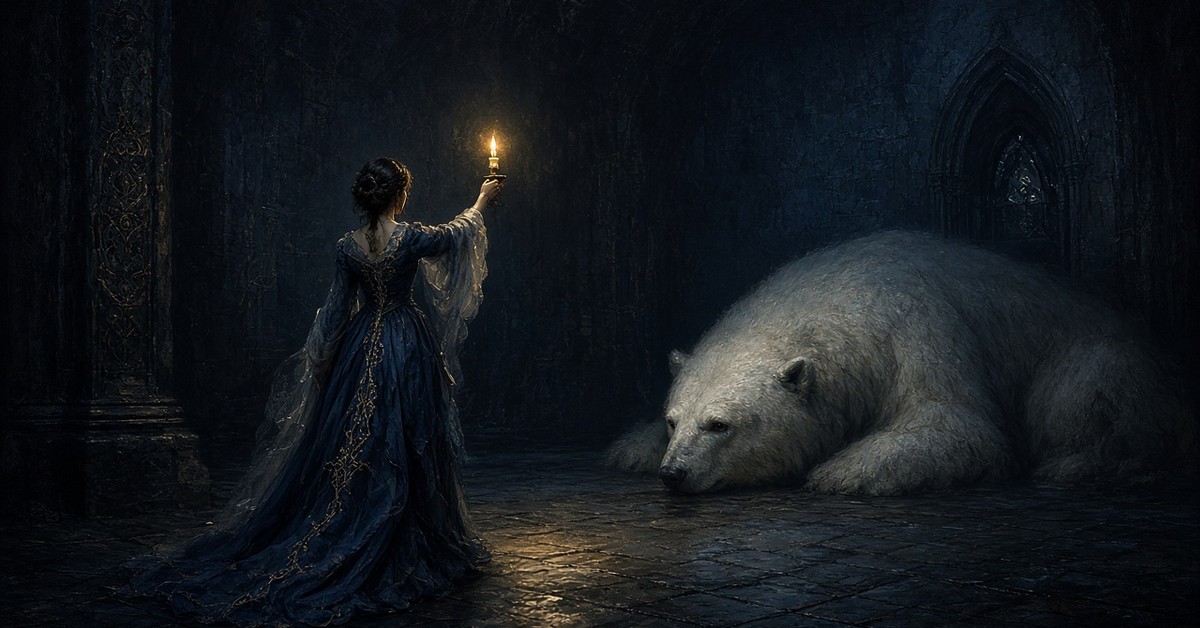
The monster has always been a lover as well as a threat. Long before the paranormal shelves of modern bookstores, people told stories about women who married beasts, men who loved creatures from the sea, and brides who discovered that their husbands were something other than they seemed. The pairing of desire with the inhuman is not a recent fashion. It is one of the oldest stories we have.
Readers today who seek out monstrous love interests are part of that long line. What draws them? The answer says a good deal about romance, about fear, and about the wish to be seen.
The animal bridegroom and the serpent wife
Folklore across Europe is full of marriages to creatures. In the Norwegian tale East of the Sun and West of the Moon, a poor family gives its youngest daughter to a great white bear in exchange for wealth. He comes to her bed each night in the dark, and when she lights a candle to see his face, she loses him and must walk to the ends of the earth to win him back. Tales of serpent husbands, frog husbands, and hedgehog husbands follow the same pattern. A woman is bound to something she fears, and the story turns on what she learns about him.
The medieval French legend of Melusine reverses the roles. A nobleman marries a beautiful woman on the condition that he never look at her on a certain day of the week. He breaks the promise, spies on her bath, and sees that from the waist down she is a serpent. She leaves him, and in many versions she takes the form of a dragon and returns only as a cry over the walls of the castle when one of her descendants is about to die.
These stories pose a question that still drives monster romance today. What is the difference between appearance and nature, and can love bear to see both?
The pleasure of difference
A monstrous love interest is different from the people the reader meets in ordinary life. He may be immensely strong, very old, or bound by rules no human follows. He may perceive the world through senses we lack. That difference creates tension, and tension is the lifeblood of romance.
When two people are alike, the obstacles between them have to come from outside. When one of them is a creature from another order of being, the obstacles are built in. Can they understand each other? Can they share a life? Is the difference between them something love can cross, or something it must accept?
Danger held in check
The monster is dangerous. That is the point of him. He could do harm, and the story knows it. What makes him compelling as a love interest is that he chooses not to, or struggles not to, or does so only in defense of the person he loves.
This idea of restrained power runs through much of the genre. A creature capable of violence who holds himself back becomes, in the logic of the story, a figure of trust. He is far from harmless. The heroine is safe with him because he has decided she will be safe. The romance lies in that decision and in the cost of keeping it.
Many people have learned to be wary of those who seem gentle and turn out to be cruel. A love interest whose danger is visible and declared can feel more trustworthy than one whose menace hides behind charm.
The outsider who understands
Monsters live at the edges. They are shunned, hunted, and misunderstood. Frankenstein’s creature, in Mary Shelley’s novel, is articulate and longing for companionship, and he becomes violent only after every human he approaches rejects him in horror. The Phantom of the Opera hides beneath the theater because the world above cannot bear to look at him.
Readers who have felt like outsiders often recognize themselves in these figures. A monster who has been feared all his life knows what it is to be judged by the surface. When he finds someone who looks at him without flinching, the moment carries enormous weight, and the reader shares it. Many monster romances are, at their core, stories about being accepted in full.
There is often a reversal as well. The heroine of a monster romance is frequently an outsider herself, someone who does not fit the expectations of her village or her family. She may be the only person able to see the monster clearly because she has spent so long being misread.
Who is the real monster
The best stories in this tradition turn the label around. The creature with fangs and claws proves loyal and capable of tenderness. The respectable humans prove cruel, greedy, or cowardly. The mob with torches is more frightening than the thing in the castle.
This reversal makes an argument about where evil lives. It asks readers to look past appearance, rank, and reputation and judge by deeds. In a genre often dismissed as escapism, that is a serious moral position.
The film The Shape of Water made the same point, giving its amphibious creature more decency than the government men who held him captive.
Folklore’s many lovers
Monster romance draws from a deep well. There are the selkies of the northern isles, the swan maidens of many cultures, the serpent husbands of Asian and European tales, and the wolf-men of medieval legend. There are revenants who return for their beloved and spirits of the water who lure travelers beneath the surface. Each brings its own rules, its own dangers, and its own kind of longing.
What these figures share is a doubleness. They are both alluring and threatening, both familiar and strange. Loving them means accepting both halves. The stories rarely let anyone keep the comfort without the danger.
Fear and tenderness together
At its heart, monster romance joins two feelings that ordinary life tends to keep apart. The heroine is afraid, and she is drawn closer. She is in danger, and she has never felt more alive. The monster frightens her, and he is the one being in the world who sees her clearly.
That combination is not comfortable, and it should not be. It is the same tension that runs through gothic fiction and much of horror. Desire is never entirely safe. Opening yourself to another being, human or otherwise, always carries risk. The monster makes that risk visible.
Reading the monster
For readers new to monstrous love interests, the old tales remain a good beginning. Read the animal bridegroom tales, the legend of Melusine, and Frankenstein with an eye to its creature’s loneliness. Then look at how later writers have taken those shapes and made them their own.
Notice what each story believes about difference. Some insist the monster must become human before love can succeed. Others refuse that ending and ask the human to step into the monster’s world instead. That choice says a great deal about what a story values. The most powerful monster romances, I think, are the ones that never ask the beast to stop being what he is.
Leave a Reply