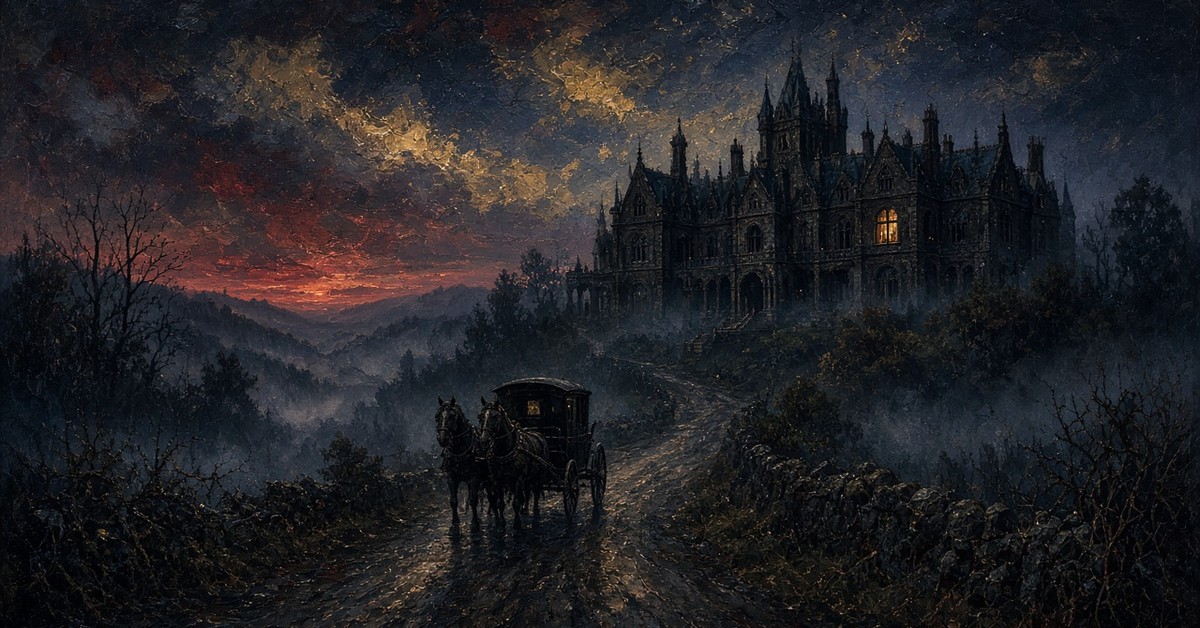
There is a particular kind of book that begins with a journey toward a house. A young woman arrives by carriage, or train, or a car that labors up a long drive, and the house is waiting for her. It is too large. Some wings are closed. The staff are polite in a way that tells her nothing. Somewhere inside lives a man whose history no one will explain, and the reader knows before the second chapter ends that the house and the man share a secret.
That is the gothic romance, and it has been with us for more than two centuries. It began in the eighteenth century, when Horace Walpole published The Castle of Otranto and Ann Radcliffe filled her novels with ruined abbeys, locked rooms, and heroines who walked through dark corridors holding a single candle. It came of age with Jane Eyre and Wuthering Heights. It was reborn in the twentieth century with Rebecca and with the paperback gothics whose covers showed a woman in a nightgown fleeing a mansion with one window lit. It has never gone away.
I want to ask why. What does this form give readers that so few others do?
The house is a mind
In a gothic romance, the setting is never only a setting. The house is a record of what has happened inside it. Its closed rooms are the things no one will speak of. Its portraits are the dead who still hold authority over the living. When the heroine explores the house, she is also exploring a family’s buried history, and very often the history of the man she is beginning to love.
This is why the genre feels so complete. The physical act of opening a door carries emotional weight. A staircase that leads to a sealed tower is also a question the heroine is not yet ready to ask. Readers feel this even when they could not name it. The architecture does the work that pages of explanation could never do.
It also explains why so many gothic novels end with fire. When the secret is finally exposed, the house that held it cannot stand. Thornfield burns. Manderley burns. Something has to be destroyed before anyone can live honestly.
Love under suspicion
Most romance asks whether two people will come together. Gothic romance asks a harder question: should she trust him at all?
The gothic hero is often brooding, withdrawn, and capable of cruelty. He may be grieving. He may be guilty. The heroine cannot tell which, and neither can the reader. That uncertainty is the engine of the story. Every tender moment is shadowed by the possibility that she is being deceived, and every frightening moment is complicated by the fact that she still wants him.
This is uncomfortable, and it is meant to be. The gothic romance understands that desire can coexist with doubt. It does not pretend that love makes a person safe. Instead it puts the heroine in a position where she must use her own judgment, gather her own evidence, and decide for herself what is true. In the best examples, the romance is earned only after she has seen everything, including the worst.
A heroine who investigates
People sometimes picture the gothic heroine as a fainting figure, swept along by events. The books themselves rarely support that picture. Radcliffe’s heroines are frightened, but they keep walking down the corridor. Jane Eyre refuses a marriage that would cost her conscience and leaves with almost nothing. The narrator of Rebecca begins timid and ends holding knowledge that changes everything.
The gothic heroine is a detective without a badge. She notices the servant who goes quiet, the room that is always locked, and the name no one will say. She pieces together what happened before she arrived. Much of the pleasure of the genre lies in watching her grow from someone who is acted upon into someone who acts.
For many readers, that arc matters as much as the romance. She learns that her fear was often a form of perception. The house really was wrong. Her instincts were right.
Why the past will not stay buried
The gothic is obsessed with inheritance. Old crimes, old debts, and old marriages press on the present. A first wife lingers in every room. A family curse passes from father to son. A will contains a clause that binds the living to the wishes of the dead.
This preoccupation gives the genre its gravity. The characters are not free to begin again, because the past has claims on them. Romance in this setting is never simple attraction. It is an attempt to build something new in a place built by other people for other purposes, and that attempt requires facing what came before.
Readers recognize this. Most of us carry family histories we did not choose. Most of us live in houses, towns, and countries shaped by events that happened long before we were born. The gothic gives that weight a physical form and then asks whether love can survive it.
The pleasure of dread
There is also a simpler answer to why gothic romance lasts. Dread is enjoyable when it is held inside a story. The slow accumulation of wrongness, the wind against the windows, and the candle that gutters at the wrong moment produce a tension that is very different from the sharp shock of a slasher film. It is patient. It builds over hundreds of pages.
That patience suits romance. Attraction in a gothic novel grows in the same atmosphere as fear. Both are made of heightened awareness, of noticing every sound and every glance. By the time the secrets come out, the reader has been living in that heightened state for a long while, and the release is all the stronger for it.
Reading the gothic today
The modern gothic romance keeps the old furniture and changes the people who move through it. Contemporary writers have brought the form to new places and new perspectives, set it in colonial estates and decaying modern cities, and let heroines confront the systems that built the great houses in the first place. The core remains. There is still a house with a secret, a love that cannot be trusted at first, and a woman who refuses to stop asking questions.
If you are new to the gothic, the classics remain the best door in. Read Jane Eyre for its moral seriousness, Wuthering Heights for its wildness, and Rebecca for the way a dead woman can fill every page. Then look for the newer writers who have taken those keys and opened other doors.
What all of these books share is a belief that love and fear are close neighbors, and that the most frightening room in any house is the one where the truth is kept. Gothic romance asks its readers to walk toward that room anyway. Two hundred years on, we are still accepting the invitation.
Leave a Reply