On the islands of the far north, in Orkney, Shetland, the Faroes, and along the coasts of Ireland and Scotland, people told stories about the seal folk. These were creatures who lived as seals in the water and could shed their skins to walk on land in human form. They came ashore on certain nights to dance on the sand. If a man found a discarded sealskin and hid it, the woman who owned it could not return to the sea. She would have to follow him home.
That is the core of the selkie legend, and it is one of the most quietly devastating love stories in all of folklore. No monster attacks from the deep. This is a tale of a marriage built on a stolen skin, and of the sea calling to someone who cannot answer.
The stolen skin
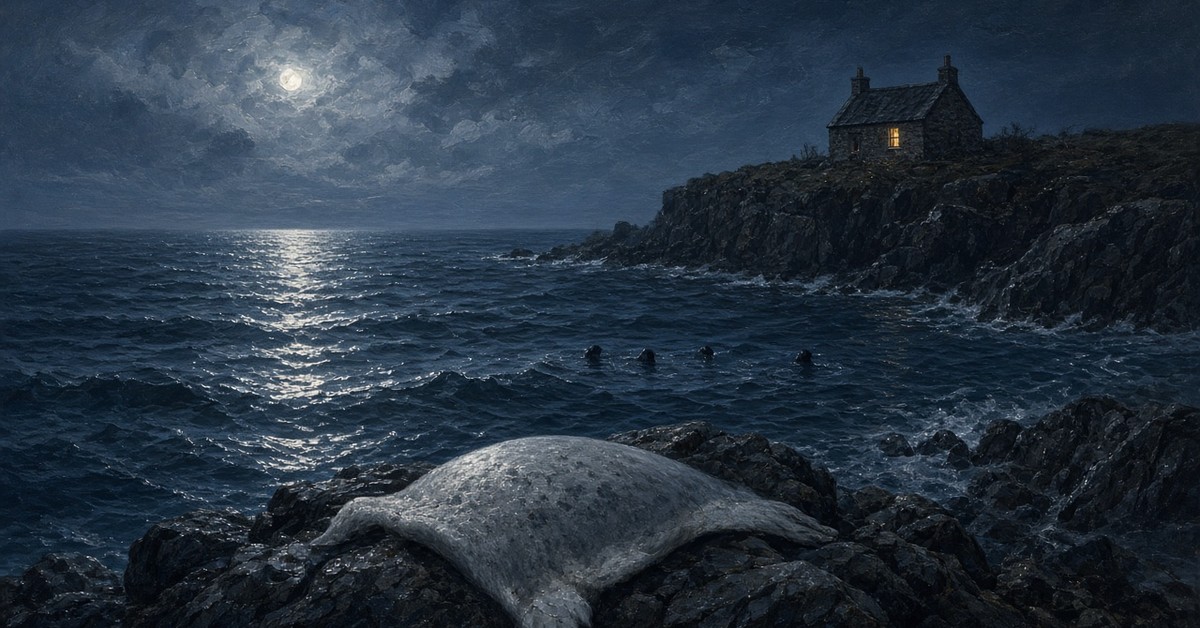
In the most common version, a fisherman walking the shore at night sees a group of seal women dancing, their skins piled on the rocks. He takes one and hides it. When the others put on their skins and slip back into the water, one woman is left behind, searching. He offers her shelter. She has no choice but to accept.
She becomes his wife. She keeps his house and bears his children. By many accounts she is a good wife, quiet and capable. Yet she is often seen standing at the shore, looking out at the water. Sometimes a large seal comes close to the rocks when she is there, and the two seem to speak.
Then one day, often through a child who finds the hidden skin and asks innocently what it is, she recovers what was taken. She goes to the sea without delay. In some versions she pauses to look back at her children. In others she does not. She never returns, though her children may see a seal watching them from the waves for the rest of their lives.
Love without consent
What makes the selkie story so haunting is its moral complexity. The fisherman may love his wife. She may come to care for him and certainly loves her children. Yet the entire marriage rests on a theft. She stays because she cannot leave. Everything good that grows from the union is rooted in that original wrong.
The tellers of these tales seem to have understood this. The selkie wife’s departure is rarely presented as a betrayal. It is presented as inevitable. The sea is where she belongs, and no amount of kindness on land can change that. When she finds her skin, the story treats her return as the restoration of something that should never have been broken.
For modern readers, this gives the legend a striking edge. It is a love story that refuses to excuse possession. It asks whether love that depends on keeping someone captive is love at all. It gives no easy answer, and that is part of its power.
The selkie husband
The legends also include male selkies, and their stories carry a different charge. In parts of Orkney and Shetland, it was said that a woman who wished for a selkie lover could summon one by shedding seven tears into the sea. The seal men were described as handsome and gentle on land, and they were said to visit lonely or unhappy wives.
These stories often have a darker side. A selkie lover might father a child and later return to claim it. A well-known ballad from the northern isles tells of a woman nursing a child whose father turns out to be a seal man, and of a grim prophecy about how father and son will meet their end. As with the selkie wife, the encounter brings something precious and leaves a lasting grief.
The pull of two worlds
At the heart of every selkie story is a being caught between two worlds. On land, the selkie can love and be loved, build a home, and raise children. In the sea, the selkie is whole and free. The two worlds cannot be joined. One must always be given up for the other.
This is why selkie legends resonate with readers who love dark romance. They are about desire that cannot be fully satisfied, about belonging divided against itself, and about the cost of choosing. The selkie’s longing for the sea is part of who she is, and no one can correct it. Any love that asks her to forget it asks her to become less than herself.
Many readers recognize something of their own lives here. People leave homelands, cultures, and families for love, and something in them goes on looking toward the shore. Others stay where they are and feel the absence of a life they did not choose. The selkie gives that divided longing a shape.
The sea as a presence
The selkie legends are inseparable from their landscape. They come from places where the sea is the center of life: islands where fishing put food on the table and where the water took husbands and sons with grim regularity. The sea in these stories is beautiful and indifferent, generous and deadly. It gives and it takes back.
The seals themselves are part of that presence. Anyone who has watched seals on a northern shore knows how human their eyes can seem, how they lift their heads to look at people on the rocks, and how their calls carry across the water at dusk. It is easy to understand how people living beside them came to believe there was something more in those eyes.
Why the legend lasts
Selkie stories have been retold in novels, poems, songs, and films, and they continue to draw readers and listeners. Part of the reason is their beauty. The image of seal women dancing on moonlit sand, their skins glistening on the rocks, is unforgettable.
But the deeper reason is their honesty about love. The selkie legend does not pretend that love conquers all. It admits that love can be built on wrongs, that it can coexist with captivity, and that some people cannot be kept no matter how much they are loved. It gives grief a place at the center of romance.
For readers who want their love stories with shadows, the selkie offers something rare: a legend that holds tenderness and sorrow together without letting either one win. The wife at the window, looking out at the water, is one of the most lasting images in folklore. She loves her children. She cannot stay. The sea is always calling, and sooner or later she will answer it.